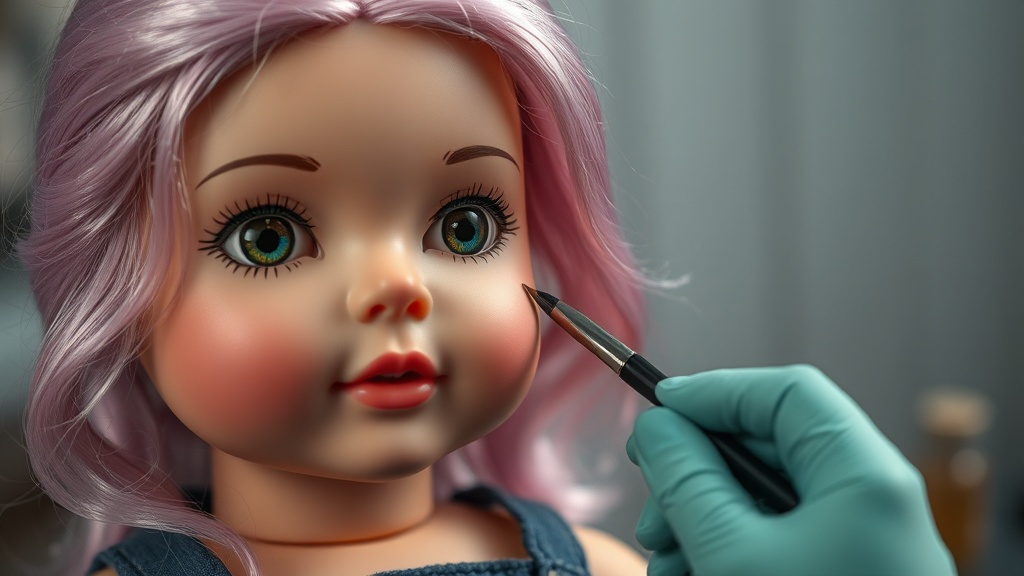
Fixing Minor Paint Loss on Doll Faces

In this guide, you'll learn how to identify, prep, and repair minor paint loss on porcelain doll faces using professional-grade techniques. We'll cover the specific tools you need for color matching, the safest ways to apply pigment to delicate surfaces, and how to avoid making the damage worse. Whether it's a tiny chip on a cheek or a faded eyebrow, these steps will help you restore the doll's aesthetic without ruining its value.
Let's be real—seeing a tiny white speck on a perfectly painted porcelain cheek is heartbreaking. It's a small detail, but it breaks the illusion of perfection. Before you grab a brush, though, you need to understand exactly what you're dealing with. Porcelain is non-porous and incredibly hard, which means paint doesn't just "soak in" like it does on wood or canvas.
What Kind of Paint Should I Use for Porcelain Dolls?
The best paint for porcelain doll repair is high-quality artist-grade acrylic or specialized oil-based pigments, depending on the original finish. You aren't just slapping on any old craft paint from a big-box store. If the original doll has a matte finish, a glossy acrylic will look like a shiny, glaring mistake. If it's a high-gloss Victorian piece, a matte paint will look dull and lifeless.
Most collectors find success with brands like Winsor & Newton or Golden Artist Colors. These brands offer a level of pigment density that cheap paints lack. You want something that can be layered in extremely thin, transparent washes. If you use a thick, opaque paint, you'll end up with a "raised" spot that catches the light—and the eye—in a way that looks amateurish.
Here is a quick breakdown of paint types for different doll surfaces:
| Paint Type | Best Use Case | Finish Level |
|---|---|---|
| Artist-Grade Acrylic | Small color corrections and detail work | Varies (Matte to Gloss) |
| Watercolors (Professional) | Softening blush or very faint color loss | Matte/Translucent |
| Oil Paints | Deep, rich color restoration (Advanced use) | High Gloss/Satin |
| Specialty Pigments | Fine-tuning texture or sheen | Highly Variable |
One thing to keep in mind: always test a tiny amount on a non-visible area first. I've seen collectors try to fix a nose chip and end up with a neon-pink nose because they didn't realize how much the color would dry down. (Trust me, it's a mistake you only make once.)
How Do I Prep the Surface Before Painting?
You must clean the area thoroughly with a soft, dry brush or a cotton swab dipped in a tiny amount of distilled water before applying any pigment. If there is dust, skin oils, or old, flaking paint in the "crater" of the chip, the new paint won't adhere properly. You want a clean, smooth surface to work with.
Avoid using harsh chemicals or heavy solvents. Many antique dolls have delicate finishes that can be easily stripped. If you use a harsh solvent to clean a chip, you might inadvertently remove the surrounding original paint. A gentle touch is the rule here. If you're working on a piece with highly intricate details, check out the Wikipedia entry on porcelain to understand the chemical stability of the material you're working on.
- Clean: Use a dry, soft-bristled brush to remove loose debris.
- Assess: Look at the chip under a magnifying glass. Is it a surface scratch or a deep pit?
- Dampen: If there is stubborn grime, use a slightly damp cotton swab (not dripping!) to lift it.
- Dry: Ensure the area is 100% dry before the paint touches it.
If the paint loss is deep, you might need a "filler" first. However, for most minor facial paint loss, you're just replacing the color. Don't go overboard with the cleaning—over-cleaning can lead to more problems than the chip itself.
How Do I Match the Color Exactly?
The most effective way to match color is to use a "layering" technique with multiple translucent washes rather than trying to find one perfect "magic color." Most doll faces aren't one solid color; they have depth, with undertones of pink, peach, or cream. If you try to paint a single dot of "skin tone," it will look like a blemish.
Start by identifying the base color of the porcelain. If the chip is on a cheek, you aren't just painting "skin," you're painting a hint of the blush that was there. I usually start with a very thin, watery layer of the base color. Once that is dry, I add a tiny bit more pigment to build the color back up. This builds depth and looks much more natural.
Here's a pro tip: use a toothpick or a single-hair brush for the actual application. A standard paintbrush is too clumsy for a doll's eye or lip. You want to "dab" the paint into the chip rather than "stroke" it. Dabbing allows the paint to settle into the texture of the porcelain naturally. It also prevents you from spreading the paint outside the boundaries of the damage.
It's worth noting that if you are working on a highly valuable piece, you might want to consult a professional restorer. If you're unsure about the value, you might want to look into why your grandmother's porcelain doll might not be worth much to determine if a DIY repair is even worth the risk. If the doll is a rare antique, a mistake here can significantly drop the market value.
What Are the Common Mistakes to Avoid?
The most common mistake is using too much paint at once. When you apply a thick glob of paint to a chip, it dries with a raised edge that looks incredibly artificial. It's much better to do five nearly invisible layers than one "perfect" layer that looks like a bump. This is especially true for porcelain, which is so smooth that any texture mismatch is immediately obvious.
Another mistake is ignoring the "sheen." A doll's face might have a subtle satin finish. If you use a matte paint, the repaired spot will look like a dead spot on the face. If you use a high-gloss paint, it will look like a wet spot. To fix this, you can use a specialized glaze or a tiny bit of acrylic gloss medium after the color has dried to match the original luster.
Don't forget the light. Always work in a well-lit area, preferably with natural light. Artificial light can distort how colors look. What looks like a perfect peach color under your desk lamp might look like bright orange under sunlight. Check your work from multiple angles and distances before you call it finished.
If you find that the damage is more than just a surface chip—perhaps a crack in the actual porcelain—stop immediately. A crack in the ceramic itself is a structural issue that paint won't fix. At that point, you're looking at a much more complex restoration process involving specialized resins and professional-grade adhesives.
One thing to watch for is the "halo effect." This happens when you're trying to blend the new paint into the old. If you're too aggressive with your blending, you'll end up with a ring of color around the repair. Keep your brush movements minimal and precise. The goal is to make the repair invisible, not to create a new feature on the doll's face.
Steps
- 1
Clean the Surface
- 2
Match the Pigment
- 3
Apply Micro-Layers
- 4
Dry and Blend